





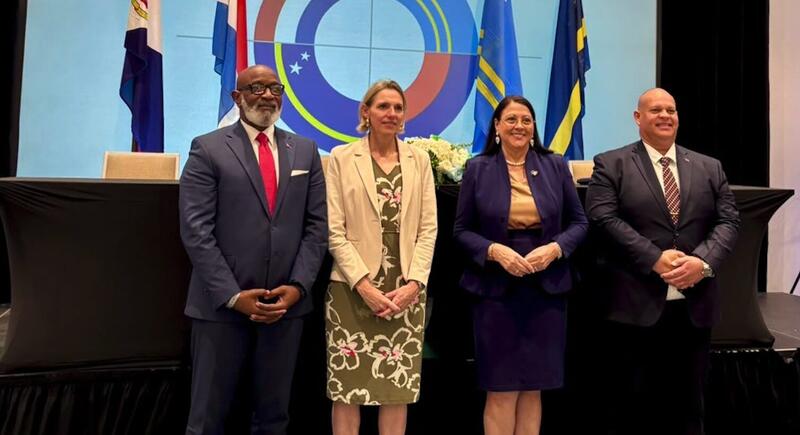
On Emancipation Day in Bonaire, we are preparing to listen to speeches by representatives of the Kingdom and the Governor. If emancipation is a true reality, who will hold the microphone today? Who will guide the narrative? The question is not only about what should be remembered, but also about who has the power to tell the story and to define its meaning.
When the main voices in the official ceremony come from institutions that have historically shaped and sustained the colonial system, a fundamental tension arises. How can we speak of liberation when the microphone is still in the hands of structures that represent the same power of the past?

Commemoration is not just a moment of reflection, but also a space where memory, power, and representation intersect and clash with one another. The questions regarding authority remain: who speaks, who is listened to, and who has the right to tell the story of emancipation?
Are we truly ready for emancipation if the narrative is still dominated by the same colonial structures that shaped our past?
On March 25, 2026, the Netherlands abstained during a vote in the United Nations General Assembly on a resolution that declared the transatlantic trafficking of enslaved Africans and the slave trade as “the most serious crime against humanity.” The resolution was approved with 123 votes in favor, while the Netherlands was among the 52 countries that abstained. Therefore, it is worth asking, if a country cannot vote in favor of a declaration that recognizes one of the darkest chapters of human history, how can the same country stand today in Amsterdam or Bonaire as a symbol of commemoration and reconciliation?
Emancipation cannot be achieved through commemoration alone. It must be translated into action. If we believe in true emancipation, concrete steps must be taken. The history of slavery and colonialism must become a mandatory part of our education system, told from a Bonairean perspective. Cultural and historical institutions must be led and strengthened to engage researchers, educators, and the local community. If our history is not in schools, we fail to meet the basic condition for emancipation. We need more investment in documenting oral history, preserving historical sites, and education in Papiamento as a language of knowledge and identity.
Emancipation also means strengthening autonomy in decision-making. This means that Bonaire must have more influence over decisions that affect its people, culture, education, and development. Representation cannot be merely symbolic; it must be real.
Perhaps the challenge for Bonaire is not only to commemorate emancipation but to continue the process of emancipation. Emancipation is not an event of one day or one month; it is a collective effort that demands representation, equality, memory, and courage to face realities that are still present.
Will there come a day when our actions, our direction, and our vision will align with our words? Will there come a day when emancipation will not just be something we remember, but something we live? Until that moment, Bonaire has the responsibility to continue to uplift its voice, to ask difficult questions, and to work towards a future where justice and dignity are not ideals, but shared realities for all people.

*This article has been automatically translated. While we strive for accuracy, some translations may contain errors.



Loading comments...